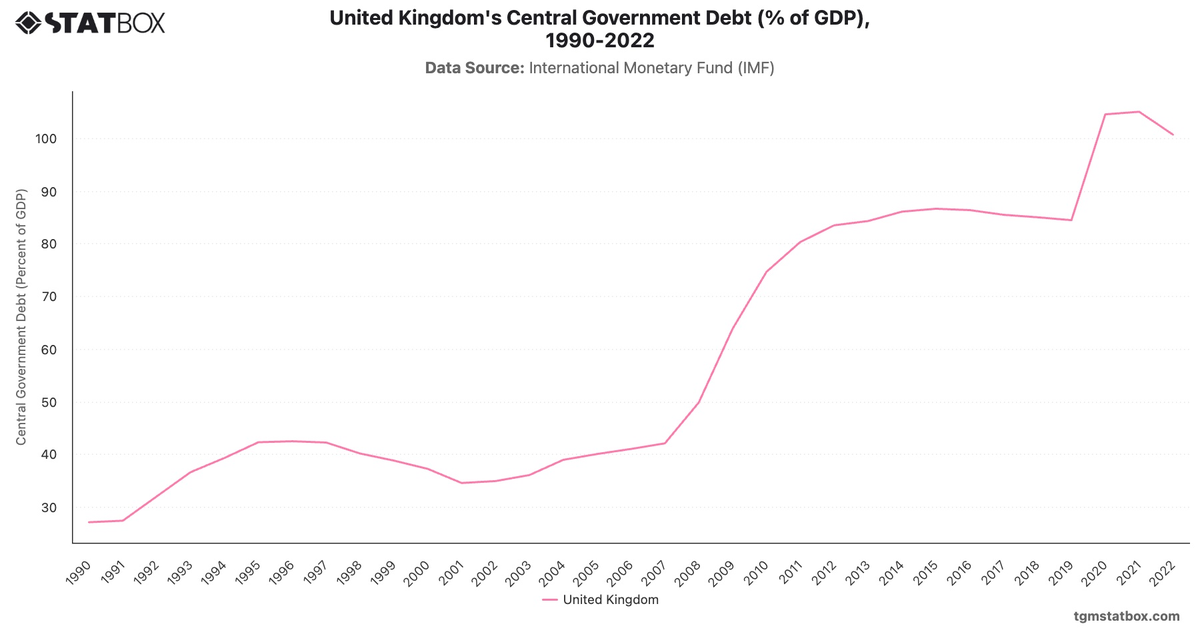
The United Kingdom's government debt rose significantly during the 1990s, increasing from 27.4% in 1990 to 44.3% in 1995 amid an economic slowdown and rising public expenditure. Debt levels stabilized through the early 2000s, reflecting a period of economic expansion and fiscal discipline. However, the 2008 global financial crisis triggered a sharp increase, with debt rising from 43.1% in 2007 to 64.8% in 2009 as the UK implemented stimulus measures to stabilize the economy.
Debt continued to climb in the following decade, peaking at 87.7% in 2015. Efforts to reduce this debt achieved limited success, and the COVID-19 pandemic caused another surge, reaching 105.9% in 2021 due to extensive fiscal support for businesses and healthcare. In 2022, debt slightly declined to 101.4%, indicating the start of fiscal recovery amidst ongoing economic uncertainties.
Debt continued to climb in the following decade, peaking at 87.7% in 2015. Efforts to reduce this debt achieved limited success, and the COVID-19 pandemic caused another surge, reaching 105.9% in 2021 due to extensive fiscal support for businesses and healthcare. In 2022, debt slightly declined to 101.4%, indicating the start of fiscal recovery amidst ongoing economic uncertainties.
For a deeper dive into the topic, explore United Kingdom’s services sector share in GDP, United Kingdom’s central government debt as a percentage of GDP, UK’s life span metric.